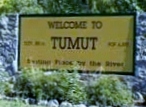
"

RUN 188. Webb Gabbett, Name of run, "Bogalegera". Estimated area, six hundred acres. Estimated grazing capabilities, seventy cattle, three hundred sheep. The river Tumut from a paddock fence, (which comes into the river bank, and which fence is there the boundary between my run and Vyner,) to a hut of G. Shelley's, which is close to the river at the other extremity of my run, from said hut a marked tree line made by Mr. Bingham, and which goes from the hut to a creek, called the Rocky Creek; divides my run from Shelley's from this point on Rocky Creek; my boundary line dividing me from Vyner is as follows, via a marked tree line of Mr. Bingham's across the range to the river flat and terminating there at a marked tree; from this marked true my boundary from Vyner Is made by my own paddock fencing and terminates at the river at this point where this description commenced. - (Ref- The Sydney Morning Herald (NSW : 1842-1954) Monday 16 October 1848)

Portion of Tumut Town Map

View of a portion of Tumut towards Bombowlee and further. Notice double story house just off centre before the Tumut River - it was build by Mr & Mrs Kindred.

Looking up the


History
Early Pioneers
Tumut & District Clubs
Churches - Tumut District & Blowering Index
Post Office
Tumut & Blowering Electricity
Telephone & Exchanges
Tumut Airport
Tumut Early Marriages
Tumut Shire Council
(BY O.H.)
"A thing of beauty is a joy for ever." When that "thing" is a thriving country town, with delightful environs, it becomes not only a joy to local resident and immigrant, but a prolific source of revenue. Who shall say that it was not this very beauty, apart from the abundance of marsupials, which many years ago led the neighbourling kings from Murrumbidgee, Monaro, and Bombowlie to assemble their people at Doomut.
As this historic meeting of monarchs there were no reportors present. Neither were any minutes taken of the subsequent conference. But the last of the Doomut tribe, who drifted to Brungle, talked big of the great assemblage. The talk-sticks had been sent round the mountains and up the winding streams which splashed merrily over the shallows on their way to the Bidgee. Then when the southern moon grew to fullness, the tribes assembled at the rendezvous. The reception of delegates, or corroboree, was a grand affair, over 500 participating. So also was the subsequent banquet. But the proceedings terminated rather abruptly. A buck from Monaro, entranced with the charms of a Fish River maiden, desired her for his lubra. She scorned the foreign yoke, so the Monaro brave, following the time-honoured custom, stunned her with a blow from his waddy. The blow was heard a hundred yards off. It was heard by a young Fish River warrior, whose mia mia the young malden had promised to grace. So the Fish River black protested with a boomorang. Monaro replied with a spear. There was a division. Spears, boomerangs, and other missiles darkened the air. Pandemonium reigned. The young gin primarily responsible for the fracas slumbered peacefully. The Doomut King, who had presided at the function, failed to restore order, and the gathering dispersed. The rather meagre details procurable from old Brungal Tommy do not include the number of killed and wounded.
After the visitors had departed the local blacks lived in peace and quiet at Doomut, which, being translated, is "The Camping Place." Stringy-bark humpies were raised. Fish in abundance came from the river, while in the ranges the warriors found kangaroo, wallaby, and bears. But soon the white man came from "over the ranges," and encroached on the happy hunting grounds of the aboriginals.
Cattle took the place of the marsupial on all the country round Doomut and Bombowlee. The blacks thinned out, and the last of the tribe migrated to Brungal. King Tommy for years held sway along the banks of the little creek that rushes and tumbles down between the mountains.
A medal presented in 1812 by Mr. John Keighrer, the original owner of Brungal, was proudly worn by the old monarch. But Tommy's end is shrouded in mystery. Tradition has it that he was speared in a fight with some raiding natives from Yass. A less picturesque but more probable story is that he and 50 of his tribe were wiped out by an influenza epidemic, which decimated the tribes in the Upper Murrumbidgee. But two years ago King Tommy's old brass medal was unearthed at Brungle, as it is now spelt. Here at the Mission Station, in charge of Mr. Hubbard, the remaining aboriginals of the district are located. When Christmas cheer comes round the population of the settlement reaches well over a hundred. Ordinarily it is about 80. And those are not by any means the degenerate blacks that one meets on the bends of the outback rivers. They are great athletes, holding their own at cricket and football, and pulling off many prizes at district sports meetings. They do all the cultivating at the station, and some of the men can plough and furrow with the best farmers of the district.
Reverting to Tumut, as the old camping place came to be called, it was 1848 before the district was settled sufficiently to warrant the visit of the Government surveyors who laid out the town. A courthouse and lockup of gum slabs and bark, with a mounted trooper and black tracker, stood as the symbols of law and order and British justice.
Postmaster and School master Hilton looked after her Majesty's mails in his spare time, inculcated into the currency lads and lasses some of the rudiments of the three R's. On the fertile Tumut "plains" were then settled the Shellys, Whitty and Blowering, Anderson and Foord occupied Tumut station; Wilkinson selected Yallowin, and Broughton held Gadara, while a Rankin squatted at Bombowlee.
It was cattle rather than sheep that occupied the attentions of the backwoodsman. But soon the hornies grew so plentiful that they became too cheap. After sending a mob all the way to Sydney the squatter only realised 16s a head. Station hands worked for three half crowns a week and their keep. Old hands still talk of the days when there were 29 boiling down establishments in the colony. That was the first or cattle era.
Then came gold. In 1848 gold was discovered at California, and a few years later in Australia. In 1851 John Bridle, now hale and hearty at 84, won the first half ounce from the Tumut River. At Talbingo, Adelong, and Gobragandra rich alluvial patches were located. Thousands of adventurous miners and prospectors made southwards from Port Jackson. And the underpaid stockmen and drovers joined in the hunt for gold. Station hands were unprocurable at £3 a week, Cattle jumped from 15s to £5 a head.
Then resulted the third or agricultural age. With the establishments of mining townships came a big demand for foodstuffs also. Tumut supplied most of the country side, right to Yackandandah, over the border. It became the granary of New South Wales. It paid handsomely to grow wheat and maize, fruits, and potatoes. Tumut grew and prospered. Broad tree lined thoroughfares were backed by offices, stores, and residences. Picturesque orchards dotted the landscape, and when the first fruit growers' conference was subsequently held in the metropolis, the Tumut delegates presented a collection which put completely in the shade the first fruits of the coast and Cumberland. Farms multiplied until the "plains" were like unto a gigantic chess board.
Dairy farmers followed, and thousands of milkers meandered along the river to their dowlaps deep in the clover feed. In the back country the grazier added his quota to the town's sustenance, and its permanence and solvency were assured. The iron horse connected the town with the metropolis. A butter factory, freezing works, flour mills, and other commercial undertakings arose to testify to the enterprise of the inhabitants.
Then the wisdom of our statesmen and the co-oporatlon of our peoplo saw the dream of a grand united Austialia crystallise into actual fact, and search was made for the capital of the continent. Experts scoured the mother State, as dreamors of old scoured the planet for the "Elixir of Life" or the Philosopher's Stone. In course of time they came to Tumut. They filled their lungs with the fresh invigorating atmosphere. They lifted their eyes to the green clad hills and saw afar off fleecy clouds clinging to the purple mountains. They wandered along the banks of the beautiful Tumut River, and heard the laughter of rippling waters, the sweet wild note of the magpie, the hilarious cachinnation of goburras, and the joyous twitterings of myriad feathered songsters.
They noted the giant poplars, the stately elms and oaks, reminiscent of old England. Luscious old world fruits delighted their epicurean palates. The despised poet of the senses inhaled the scent of new mown hay and the honeyed sweet of wattle bloom and gum. Beyond were the fan- tastic stalagmitess and stalactites of Yarrangobilly, the wonder of thermal springs, the fern-fringed gorges of Younama, and, loveliest of all, the white veil of laughing water the splashing silver crystals of Budding Falls.
The senses enjoyed a galaxy of beauty. It was only what was expected when beautiful Tumut was chosen as the ideal site for the capital of Federated Australia Politics, however, is a complex game, in which the players make many strange moves. As the cards were shuffled again and again other sites came uppermost, and Tumut, queen of them all, slippod unnoticed to the bottom of the pack. Wistfully the locals saw the coveted honour-amost within their grasp fade away. But though robbed of the supreme distinction Tumut must over be the resort of the world-weary, the poet, the artist, the sportsman, and the tourist. Not without reason has Tumut been called the prettiest town in Australia. Enthusiasts may sigh for the glory which might have been; but he who has heard the song of the "Out of Doors," and knows the love of forest and fen, will never regret that the peaceful calm of Tumut River has been spared the intrusion of the politician and the demagogue. - (Ref- The Sydney Morning Herald (NSW : 1842-1954) Saturday 11 June 1910).
1870 Appointment of ENUMERATORS for the CENSUS.
Gentlemen appointed to be Enumerators under the provisions of the NSW Census Act for 1871. Full list given.
[Government Gazette, 8 December, 1870, p.2731.]
Tumut - Henry HILTON; - (Ref- http://www.dcstechnical.com.au/Rusheen/1.0_People.htm)
1880 - Tumut Certified Denominational Roman Catholic School - Mr Thomas CORCORAN, Teacher.
Page 511
Distance 259 miles South of Sydney Mail closes at General Post Office daily 4 pm. Mail arrives at Post Town daily (Tuesday excepted) 4 pm. Mail leaves for Sydney daily (Friday excepted) 4 pm. Mail arrives at Sydney daily 7.15 am. Route - Rail Goulburn, and coach Adelong, 10m. Tumut.
(Ref- Greville's 1872 Post Office Directory ).
ALLATT, Joseph blacksmith Caper St. Tumut - (Note spelling of the original record)
ANDERSON, Elias carpenter --- Tumut
BARNES, Denis farmer --- Tumut
BELL, A. C. road overseer Merivale St. Tumut
BLAIR, Miss teacher --- Tumut
BLAKENY, James saddler Wynyard St. Tumut
BLOMLEY, James farmer Tumut River Tumut
BONYNGE, Thomas teacher Fitzroy St. Tumut
BRIDLE, George photographer --- Tumut
BRIDLE, Thomas farmer --- Tumut
BRIDLE, William sen. --- Fitzroy St. Tumut
BROOKS, William watchmaker Fitzroy St. Tumut
CARR, James bailiff Tumut Tumut
CASSIDY, John miner Wynyard St. Tumut
CRAMPTON, David baker Wynyard St. Tumut
DEAN, Charles road contractor --- Tumut
DEAR, Robert innkeeper Russell St. Tumut
DODD, John butcher Russell St. Tumut
DODD, Thomas butcher Russell St. Tumut
DONNELLY, John farmer --- Tumut
DONOHOE, Daniel farmer Tumut Tumut
DOWSETT, George farmer Russell St. Tumut
EBERLEIN, Frederick carpenter Merivale St. Tumut - (Note spelling of the original record)
EBZERRY, Patrick labourer --- Tumut
EGGLETON, Thomas blacksmith Wynyard St. Tumut
EGGLETON, William blacksmith Wynyard St. Tumut
FITZGERALD Edward innkeeper Fitzroy St. Tumut
FORD Francis wheelwright --- Tumut
FRENCH Daniel jun. householder --- Tumut
GRIST Louis draper Wynyard Tumut
HASSETT John farmer --- Tumut
HASTINGS John farmer Cocup Tumut - (Note spelling of the original record)
HAY John squatter Cocup Tumut - (Note spelling of the original record)
HAYDEN William carpenter Fitzroy St. Tumut
HEALY Thomas farmer Lucmiluc Tumut - (Note spelling of the original record)
HECTOR James surgeon --- Tumut
HIBBINS James farmer Gilmore Tumut
HIBBINS William farmer --- Tumut
HILTON Henry postmaster Russell St. Tumut
HOAD George builder Fitzroy St. Tumut
HOAD George jun. saddler Fitzroy St. Tumut
HORCH Stephen gardener --- Tumut
HOWARD George bootmaker Russell St. Tumut
HOWSE Charles tailor Russell St. Tumut
HOWE Thomas carrier --- Tumut
JOHNSTON William constable --- Tumut
KEEF James bootmaker Fitzroy St. Tumut
KEENAN Patrick butcher Russell St. Tumut
LARKINS Frank constable --- Tumut
LENEHAN George teacher Russell St. Tumut
LINKEY Adolphus bricklayer Wynyard St. Tumut
LONERGAN William blacksmith Russell St. Tumut
LUSTY Charles farmer --- Tumut
LYNCH M. teacher --- Tumut
LYNCH Robert MD Queensville Tumut
MADDEN James carrier --- Tumut
MADIGAN Bridget innkeeper Fitzroy St. Tumut
MANDELSON Levy storekeeper Wynyard St. Tumut
MARVELL George butcher Russell St. Tumut
MITCHELL Robert clerk --- Tumut
MORRIS Edward miner Russell St. Tumut
MURPHY Thomas carrier --- Tumut
MCALISTER John carrier --- Tumut
MCCALLUM Duncan carrier --- Tumut
MCDONALD John stockholder --- Tumut
MCINERNEY James bootmaker Fitzroy St. Tumut
MCKAY Richard innkeeper Fitzroy St. Tumut
MCKENZIE Kenneth --- --- Tumut
MCLAREN Thomas tailor Wynyard St. Tumut
MCNAMARA M. innkeeper Fitzroy St. Tumut
NEWMAN Robert storekeeper Fitzroy St. Tumut
O’KEEFE Patrick bootmaker --- Tumut
O’MARA Edward --- Fitzroy St. Tumut
QUILTY Michael innkeeper Russell St. Tumut
RAESIDE James carpenter Copper St. Tumut - (Note spelling of the original record)
RATLIFF Charles --- Walongawah Tumut - (Note spelling of the original record)
REARDON John butcher Wynyard St. Tumut
RITZAN Henry innkeeper Wynyard St. Tumut
ROBERTSON & BARRYMORE solicitors Wynyard St. Tumut
ROUSE Edward --- Fitzroy St. Tumut
SIMPSON William saddler Russell St. Tumut
SWIFT S. commission agent . Fitzroy St Tumut
TOOHY Martin storekeeper Wynyard St. Tumut
TWOMEY Rev. Cornelius (RC) Fitzroy St. Tumut
VERNON Martin clerk Fitzroy St. Tumut
WEDEN John clerk --- Tumut
WILKINSON John squatter Yellowen Tumut - (Note spelling of the original record)
WILKINSON Thomas squatter Yellowen Tumut - (Note spelling of the original record)
WILSON Robert poundkeeper Gilmore Tumut
WOOLLEY William miller --- Tumut
ZOELLNER --- Police sergeant --- Tumut
THE BEE HIVE STORE, TUMUT.
R. A. NEWMAN, GENERAL STOREKEEPER, TUMUT. WHEAT, OATS, AND MAIZE ALWAYS ON HAND IN LARGE QUANTITIES.
J. BLAKENEY, SADDLE AND HARNESS MAKER, WYNYARD STREET, TUMUT. ALL DESCRIPTIONS OF LADIES' SADDLES AND RACE SADDLES MADE TO ORDER.
H. HILTON, AUCTIONEER AND COMMISSION AGENT, TUMUT.
THE TUMUT DISPENSARY. L. CASPERSONN, CHEMIST AND DRUGGIST, ALSO, PRINTER, BOOKSELLER, STATIONER, AND SEED MERCHANT. A LARGE STOCK OF PERFUMERY AND FANCY GOODS ALWAYS ON HAND. WYNYARD STREET, TUMUT.
G. BRIDLE, PHOTOGRAPHER, TUMUT. COPIES OF ALL PHOTOGRAPHS THAT HAVE BEEN TAKEN CAN BE OBTAINED AT ALL TIMES, BY APPLYING TO G. BRIDLE, TUMUT.
[A CARD] J. HECTOR, SURGEON, &C., TUMUT.
Web Master: John Stephenson, (Mobile 0431 481 451) Ex West Blowering Resident, now living in Wollongong, NSW. Australia. Email - johnstephenson@acnrep.com
To Home page