
TUMUT, NSW.
AUSTRALIA
Always in the back ground, guarding the Blowering Valley from the south.
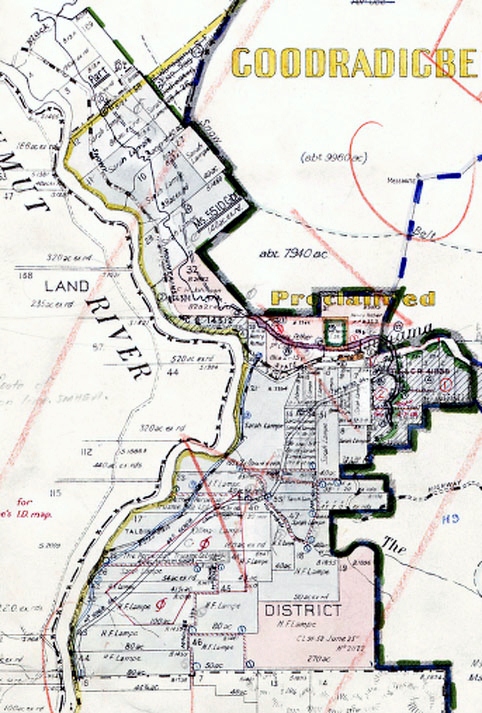
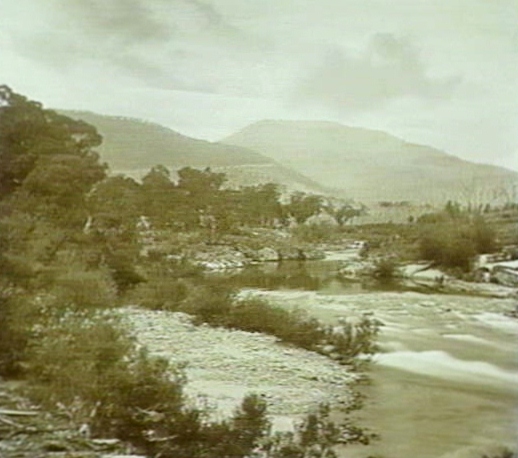
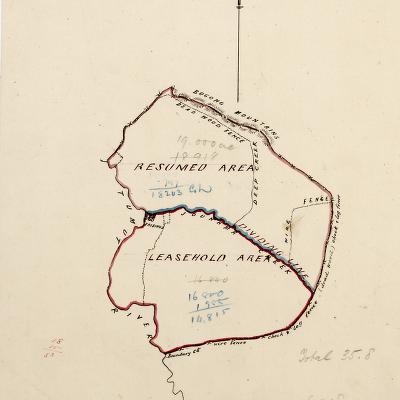
The branch line which runs east from Cootamundra terminates at Tumut, which Is delightfully situated on the banks of the Tumut River. Descending from the high mountains eastward of Tumut the river runs rapidly until It eventually reaches the steadier waters of the Murrumbidgee. Near the town it's banks are encompassed. In the drooping willows which provide many a shady nook for boating parties. Besides boating and swimming, there is ample sport with trout in the river. Coaches run regularly to tho Yarrangobilly Caves, via Talbingo Mountains, which in winter often wears a mantle of snow. There are many up-to-date hotels in the town. - (Ref- The Sydney Morning Herald (NSW : 1842-1954) Tuesday 26 September 1911.)
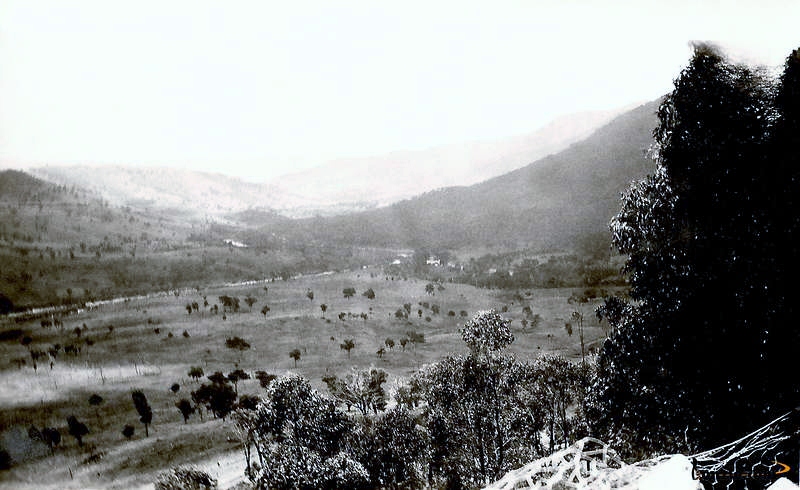
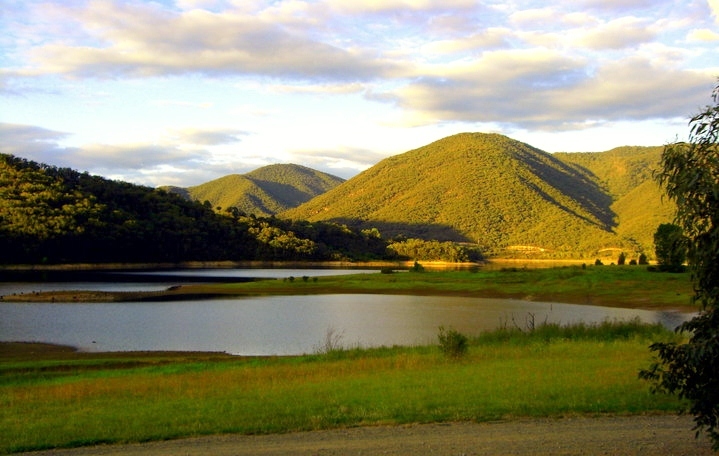
The Day family - last owners of Talbingo Station never thought that this would be the scene !!!!
It is hard to write about Talbingo (which I knew very well as a child) without feeling that here, of all the places in the Snowy Mountains, is the one town which should have been protected from the ravages of Snowy Mountains Scheme. It was a tiny township full of fascinating history which extended far beyond its boundaries. It was the town where Miles Franklin, of My Brilliant Career fame, was born. The local Talbingo Hotel, apart from its wonderful bar sketch by Rufus Morris (the cartoonist famous for his work on the 'It's moments like these you need Minties'), was known for its trout fishing and its wildness which once extended to a man riding his horse into the main bar and shooting a hole in the roof with a shotgun. Ken Murray, at the time the successful publisher of Man and House and Garden magazines, built himself an eyrie on the top of a hill behind the town - it can still be seen from the lookout at Tumut Ponds Dam. And it was the beginning of one of the worst roads ever built in this country - a winding track which made its way via Yarrangobilly, Rules Point and Kiandra to Adaminaby and Cooma.
It was, by any measure, a beautiful place where the Talbingo and the Jounama creeks made their way through rugged country and the autumn colours of the willows and poplars beside the creeks were a joy to behold. Few people who experienced the area in childhood ever forgot it. Miles Franklin, in Childhood in Brindabella writes of Talbingo: 'No other spot has ever replaced the hold on my affections or imagination of my birthplace, nor are any other incidents so clearly and tenderly etched in my memory as those connected with it.' Elsewhere she wrote of the ferny gullies, to the sweet, and rush of many mountain waters'. Much of the magic of the area has been captured in Jack Bridle's excellent book Talbingo.
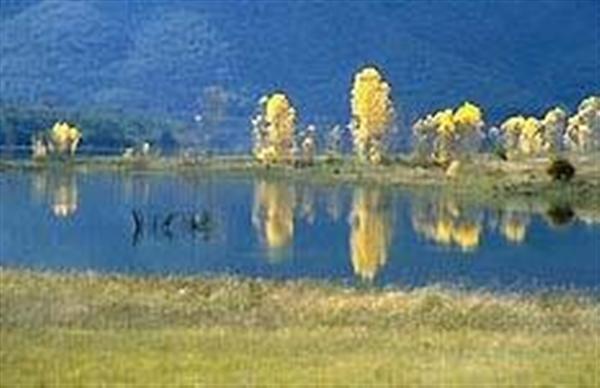
Today Talbingo is a neat little township located on the foreshores of the Jounama Pond (it's really a dam) which lies at the bottom of the Tumut 3 Power Station. It is 462 km from Sydney, 42 km from Tumut and 412 metres above sea level. Like Khancoban to the south it nestles under the Snowy Mountains which rise immediately behind the town. The new town was originally one of the many camps established by the Snowy Mountains Authority but, being outside the Kosciusko National Park, it has not been subject to the restrictions which have been imposed on settlements like Jindabyne and Cabramurra. The houses in the township are now mostly privately owned and there are a number of privately owned businesses.
The town's past history is now drowned under the Jounama Dam. This is dramatically demonstrated by the sign on the way into town which reads 'Original Lampe Homestead - Birthplace of Miles Franklin in October 1879 - 500 metres'. Don't go looking for the homestead. The arrow which accompanies the '500 metres' indicates that what is left of the homestead is now under the waters of the Jounama Pond. In the same vicinity also lies the remnants of Talbingo Station.
It is worth recalling that Franklin's mother, who at the time was living in Brindabella some 100 km away, made the journey by horse and sulky to her parent's home, Lampe Homestead, to give birth.
HISTORICAL TEXT
WILLIAM BRIDLE was born in Somersetshire, England, in 1797, and arrived in Australia in 1815. He was employed for some time about Sydney, chiefly in agricultural work, and was one of the members of the first expedition, which, in the time of Governor Macquarie, crossed the Blue Mountains. For his services in this connection he was rewarded with a grant of land near Liverpool. Later he took up land on Manaro, and appears as the lessee of a run containing 12,000 acres, and known as Island Lake (now Wambrook), which was acquired later by Wallace and Ryrie. In 1848 he left Manaro for Talbingo. In 1866 he sold out his Talbingo property to Mr. Lampie. He died at Tumut in 1873. Bridle Creek, near Wambrook, takes its name from him.
"BACK TO COOMA" Felix Mitchell 1926 Page 74 - Transcribed by Pattrick Mould 2002 - (Lyn Langley)
In 1866 Bridle sold out to Lampe who was Miles Franklin's grandfather. Lampe's property was known as Talbingo Station. It remained the centre of the community until the site was finally drowned by the filling of the Jounama Dam in 1968.
So what does the modern town have to offer? In Bridle Street there is a cairn and park commemorating the fact that Talbingo was the birth place of Miles Franklin.
Modern Talbingo is a town where the architectural style is very much 'SMA Construction Town circa 1960'.
Oakland on Long Run
The highest town in Australia, Kiandra, was visited recently by Mr. S. Plush, of Nuriootpa, who with five others and a large load of luggage, drove an Oakland car 2,160 miles through Berri, Mildura, Euston, Hay, Junee, and Talbingo to Koscuiosko, N.S.W., and back, in order to see the Blue Mountains. Floods in several towns on the way necessitated ploughing the car through mud for miles at a time. Although bogged several times, the car pulled but under its own power, and negotiated with ease a difficult patch of sand. At Talbingo (N.S.W.), a seven mile climb was made in second gear, and after visiting the Yarrangobilly Caves the party travelled on to Kiandra.
So cold was the atmosphere here that hot water had to be put in to start the car, and the brake bands were frozen to the drums. From Kosciusko the party went high up in the mountains, until a snowdrift made further progress an impossibility.
The return trip was made through Boomboola and Bairnsdale to Melbourne, thence through Mortlake, Hamilton, Mount Gambier, Kingston, and Strathalbyn, to Adelaide. - (Ref - The Mail (Adelaide, SA : 1912-1954) Saturday 4 July 1925).

at Jones's Bridge, Wermatong and the West Blowering areas are * Indicated in a report listed in the NSW Government Gazette on 9th July 1965. This being their official notification of a date to restart their futures.
J.B.RIDLE - ? acres
C.A. DUNN - ? acres
W.J. MOOREHEAD - ? acres
J. RAMSBOTHAM - ? acres
Estate of the late W.J. & Mrs M.J & Mr B.M.) - 583 acres
T.B. GUY - 4 acres
Mrs H PETHER - 13 acres
E.W & H SMITH - 2 acres
Mrs E.M BROWN - 3 acres
A. DAY - 99 acres
Mrs A.N. BUSH - 4 acres
C.A. HUDSON - 5 acres
Mrs S ROBERTS - 1 acre
Mrs A.M. DOYLE - 22 acres
E.W. SIMMONDS - 2 acres
M.G. BUSH - 82 acres.
BRIDLE.-September 22, at Tumut. William Hendy Bridle, beloved father of Ethel, Tessie, and Madge Bridle, and Beatrice Franklin. - (Ref- The Sydney Morning Herald (NSW : 1842-1954) Wednesday 24 September 1919).